affiliate marketing

Friday, 3 August 2012

CS2406 Open Source Lab-LM


CS2406 Open Source Lab-LM

    HYPERTEXT PREPROCESSOR(PHP)          

What is PHP

  • PHP stands for PHP: Hypertext Preprocessor
  • PHP is a powerfull tool for making dynamic and interactive web pages.
  • PHP is the widely used, free, and efficient alternative to competitors such as Microsoft’s ASP.
  • PHP is a server-side scripting language, like ASP
  • PHP scripts are executed on the server
  • PHP supports many databases (MySQL, Informix, Oracle, Sybase, Solid, PostgreSQL, Generic ODBC, etc.)
  • PHP is an open source software
  • PHP is free to download and use 

Sunday, 29 July 2012

Microprocessor & Microcontroller Model Questions

CYCLE TEST – III

DEPARTMENT OF COMPUTER SCIENCE AND ENGINEERING

Sub Code : CS2252 Year : II

Subject Name : Microprocessor & Microcontroller Semester : IV

Total Marks : 60 Duration : 2 hrs

PART-A

Answer all the questions 10x2=20 Marks

  1. What is coprocessor?
  2. Name the three bus allocation schemes used in loosely coupled multiprocessor configuration
  3. What are the functional parts of control unit in 8087
  4. How many I/O channel are available in8089
  5. What is DMA data transfer
  6. What is key de bouncing
  7. Draw the command word format for 8251
  8. What are the modes of operation in 8253?
  9. What is the difference between simplex and Duplex?
  10. Draw the command word format for 8255.

PART - B

Answer any Four Questions 4 x10 =40 Marks

11. Explain in detail with neat diagram about the keyboard and display controller (10)

12. Describe the architecture of 8253 (10)

13. Explain the programmable interrupt controller 8259 with neat diagram (10)

14. Explain in detail about the multiprocessor configuration (10)

15. Explain the architecture of 8089 with neat diagram (10)

Saturday, 21 July 2012

COM+: Definition

COM+ Tutorial from Scratch has two parts. Part I has basic concept of COM+ and its related topics. Part II will teach you how to use COM+ in real world applications.


This article is an extended version of my previous article " What COM+ exactly is?". This tutorial explains what is COM+ and how it works in real world applications. I have used Windows 2000 and VC++ 6.0.
Windows DNA is the first steps to understand COM+.
Windows DNA
Windows DNA is a framework that describes how to develop multi-tier, high performance, scalable, and distributed applications over the network. The goal of DNA is to provide enterprise level solutions which is suitable for any size. The heart of DNA is an integrated programming model based on COM+. In other words, Windows DNA is a way to provide an enterprise based solutions from Microsoft.
Windows DNA Architecture :
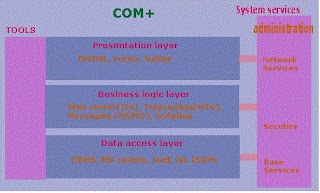


Windows DNA consists of three layers

1. The Presentation Layer


This layer is responsible for information gathering from user, performing basic validation of user input, sending it to the business layer and again receiving results of the business layer and presenting these results to the user in a viewable formats such as VB forms. This layer consists tools such as VB, HTML, DHTML, Win32 applications, Client-Server scripting, Java Applets, Netscape Plug-Ins, ActiveX controls

2. The Business Layer

This layer is responsible for receiving input from the presentation layer, interacting with the data access layer to process the information and sending back the processed information to the presentation layer. This layer provides business rules and services to help to write scalable applications. These services are tightly integrated with each other and the underlying operating system and exposed in a unified way through COM. They include the following:
Web services, through Microsoft Internet Information Server ( IIS ).
Transaction and component services, through Microsoft Transaction Server ( MTS ).
Queuing and asynchronous services, through Microsoft Message Queue Server ( MSMQ).
Server-side scripting, via Active Server Pages (ASP).
Interoperability services, such as the COM Transaction Integrator ( COMTI ) for accessing the IBM Customer Information Control System (CICS) and IBM Infromation Management Systems (MIS).
3. The Data Access Layer
This layer directly interact with the data which usually reside in the databases such as SQL Server or Oracle. This layer is responsible for storage, retrieval, and general maintenance of data as well integrity of data. The Windows DNA approach of data access is called "Universal Data Access'. UDA is a set of system level and application level programming models called OLE-DB, ADO and RDO.
COM+: Definition

In 1992, Microsoft evolved OLE ( Object linking and embedding ) which was named as COM ( 1995 ) later with new enhancements and features. In 1996, COM started supporting distributing computing and Microsoft named it as DCOM ( Distributed COM). At the same time Microsoft developed one new transaction server called Microsoft Distributed Transaction Coordinator (MDTC) which was enhanced to Microsoft Transaction Server (MTS) in 1997. In 1997, Microsoft developed one more server for queuing services called Microsoft Message Queue Server ( MSMQ). Now what??? After all these development, In 1999, Microsoft combined all these services in an integrated runtime environment which is called COM+. In other words, COM+ is an integrated environment which provides developers COM, MTS, MSMQ and some other services.

Monday, 16 July 2012

CS2251 -DESIGN AND ANALYSIS OF ALGORITHMS UNIT I QUESTIONS 1


16.            What do you mean by ²Best case-Efficiency” of an algorithm?
The ²Best case-Efficiency” of an algorithm is its efficiency for the Best-case input of size n, which is an input(or inputs)  of size n for which the algorithm runs the fastest among all possible inputs of that size.
    Ex: if you want to sort a list of numbers in ascending order when the numbers are given in ascending order. In this running time will be the smallest.


17.            Define the ²Average-case efficiency” of an algorithm?
The ²Average-case efficiency” of an algorithm is its efficiency for the  input of size n,  for which the algorithm runs between the best case and the worst case among all possible inputs of that size.

18.            What do you mean by “Amortized efficiency”?
The “Amortized efficiency” applies not only a single run of an algorithm but rather to a sequence of operations performed on the same data structure. It turns out that in some situations a single operation can be expensive ,but the total  time for an entire sequence of n such operations is always significantly better than the worst case efficiency of that single operation multiplied by n. This is known as “Amortized efficiency”.

19.            How to measure the algorithm’s efficiency?
It is logical to investigate the algorithm’s efficiency as a function of some parameter n indicating the algorithm’s input size.
Example: It will be the size of the list for problems of sorting, searching, finding the list’s smallest element, and most other problems dealing with lists.

20.            What is called the basic operation of an algorithm?
            The most important operation of the algorithm is the operation contributing the most to the total running time is called basic operation of an algorithm.

21.            How to measure an algorithm’s running time?
Let Cop be the time of execution of an algorithm’s basic iteration on a particular computer and let C (n) be the number of times this operation needs to be executed for this algorithm.  Then we can estimate the running time T(n) of a program implementing this algorithm on that computer by the formula
                                    T(n)   ≈  Cop C(n)

22.            Define order of growth.
            The efficiency analysis framework concentrates on the order of growth of an algorithm’s basic operation count as the principal indicator of the algorithm’s efficiency.  To compare and rank such orders of growth we use three notations
1)                                                      O (Big oh) notation
2)                                                      Ω (Big Omega) notation &
3)                                                      Θ (Big Theta) notation

23.            Define Big oh notation May/June 2006, April/May 2008
A function t(n) is said to be in O(g(n)) denoted t(n) ε O (g(n)), if t(n) is bounded above by some constant multiple of g(n) for all large n, i.e., if there exist some positive constant c and some non negative integer n0 such that
                                    T (n) < c g (n) for n > n0

CS2251 -DESIGN AND ANALYSIS OF ALGORITHMS UNIT I QUESTIONS


CS2251 -DESIGN AND ANALYSIS OF ALGORITHMS

UNIT –I

  1.                What is an Algorithm?  May/June 2006, Nov/Dec 2008
An algorithm is a sequence of unambiguous instructions for solving a problem, i.e., for obtaining a required output for any legitimate input in a finite amount of time

2.                State the Euclid’s algorithm for finding GCD of two given numbers.
ALGORITHM Euclid (m, n)
// Computes gcd(m,n) by Euclid’s algorithm
//Input   : Two nonnegative, not-both-zero integers m and n
//Output: Greatest common divisor of m and n
while n ¹ 0 do
                                    r ß m mod n
                                    m ß n
                                    n ß r
return m.

3.                What are Sequential Algorithms?
The central assumption of the RAM model is that instructions are executed one after another, one operation at a time. Accordingly, algorithms designed to be executed on such machines are called Sequential algorithms.

4.                What are Parallel Algorithms?
The central assumption of the RAM model does not hold for some newer computers that can execute operations concurrently, i.e., in parallel algorithms that take advantage of this capability are called Parallel algorithms.

5.                What is Exact and Approximation algorithm?
The principal decision to choose solving the problem exactly is called exact algorithm.
The principal decision to choose solving the problem approximately is called Approximation algorithm.

6.                What is Algorithm Design Technique?  Nov/Dec 2005
            An algorithm design technique is a general approach to solving problems algorithmically that is applicable to a variety of problems from different areas of computing.

7.                Define Pseudo code.

A Pseudo code is a mixture of a natural language and programming language like constructs. A pseudo code is usually more precise than a natural language, and its usage often yields more succinct algorithm descriptions.